
In the long history of cricket, right-handed players have dominated the numerical landscape. From junior academies to the international stage, roughly 80 to 85 percent of all bowlers operate with their right arm. This statistical reality creates a subtle yet profound asymmetry: batters build their career foundation, reflexes, and visual recognition patterns around standard right-arm trajectories.
Enter the left-arm bowler. Whether unleashing lethal 145 km/h inswingers or spinning the ball away from right-handed batters on a deteriorating pitch, left-armers possess a natural disruption factor. They are cricket's ultimate tactical wildcard—a rare species capable of turning matches on their head simply by virtue of the geometric angles they create.
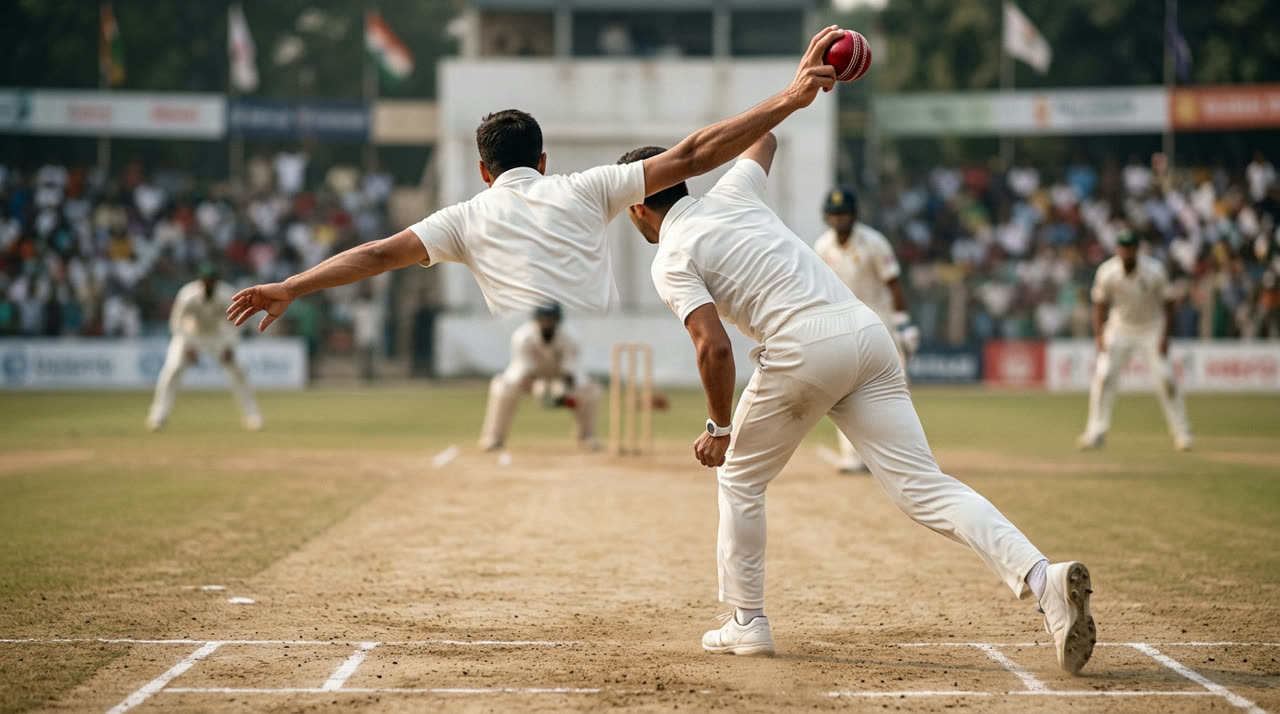
The Geometry of Release: Changing the Sightline
To understand why left-arm bowling is inherently difficult to face, one must look at the geometry of the crease. When a right-arm fast bowler operates over the wicket to a right-handed batter, the ball originates from roughly the same side of the wicket as the batter's eyes. The line of delivery is relatively straightforward, traveling straight or moving away toward the slips.
A left-arm bowler operating over the wicket presents a completely inverted visual puzzle. The ball starts wide outside the batter's off-stump alignment and angles sharply inward toward the stumps. This diagonal vector forces the batter's eyes to track movement across two distinct axes simultaneously: lateral travel across the pitch and forward momentum down the pitch.
This unique sightline alters how batters judge line and length. A ball that looks as though it is drifting wide can suddenly hit the top of off-stump. Conversely, a ball angling into the pads tricks the batter into playing across the line, leaving them vulnerable to two of cricket's most decisive dismissals: Leg Before Wicket (LBW) and Bowled.
- Inverted delivery path forces batters to track diagonal trajectories rather than parallel ones.
- Crucial decision-making time is reduced by a fraction of a second due to unfamiliar release points.
- Natural angle automatically brings both edges of the bat into play.
The Deadly Left-Arm Pace Inswinger
There are few sights in modern sport as captivating—or terrifying—as a top-tier left-arm fast bowler with a brand-new seam delivery. When a left-arm paceman gets the new ball to swing back late into a right-handed opening batter, it becomes perhaps the hardest ball in cricket to defend.
Because the ball begins its path wide of the crease, the batter's brain calculates that the ball will clear the off-stump or slip past the outside edge. However, as aerodynamically induced swing takes effect mid-flight, the ball curves sharply back toward the front pad and middle stump. To defend this, the batter must bring their bat around their front pad, creating a dangerous gap between bat and pad.
Historically, iconic opening spells from elite left-arm pacers have shattered world-class top orders within the first three overs of an inning. The combination of high speed, steep release angle, and late inward swing converts ordinary defensive technique into high-risk guesswork.

Left-Arm Spin: The Art of Disruption and Footmarks
The left-arm advantage is far from exclusive to fast bowlers; slow left-arm orthodox spinners and left-arm wrist spinners (often historically termed chinamen) offer equally potent tactical benefits. In multi-day Test cricket, slow left-arm bowling becomes a team's sharpest weapon during the late stages of a match.
As a match progresses, right-arm fast bowlers running down the pitch leave deep, rough footmarks in the turf on the left-handed side of the pitch. For a slow left-arm orthodox bowler, these footmarks become a goldmine. Pitching the ball into this uneven ground causes unpredictable turn, variable bounce, and puffing dust that blinds right-handed batters.
Beyond pitch conditions, left-arm spinners possess a natural trajectory advantage against right-handed batters. Their stock ball spins away from the right-hander—toward the slip cordon or wicketkeeper. Turning the ball away from the batter's body is fundamentally safer and more dangerous than turning it into the pads, as it routinely lures batters into reaching outside their balance zone.
- Slow left-arm spinners turn the ball away from right-handers, catching the outside edge.
- They naturally exploit footmarks created by right-arm seamers on days four and five of Test matches.
- Left-arm wrist spinners add unpredictable mystery with turns in both directions.
The Scarcity Principle and Net Training Gaps
Why don't elite international batters simply adjust to left-arm bowlers through continuous practice? The answer lies in the Scarcity Principle. Throughout a cricketer's developmental years, 8 out of 10 bowlers they face in net sessions, club matches, and regional tournaments are right-handed.
Motor skills, muscle memory, and ball recognition are built on repetition. Facing hundreds of thousands of right-arm deliveries trains a batter's brain to instantly calculate bounce, seam direction, and field placements automatically. When a left-arm bowler enters the attack, those deeply ingrained automatic subconscious calculations are suddenly misaligned.
Even at the professional level, teams often struggle to source quality left-arm net bowlers to simulate match conditions during pre-series training camps. This perpetual deficit in exposure means that even world-class batters retain a minor visual latency when facing left-arm angles under pressure.

Tactical Deployment in Short-Form Formats
In modern T20 and ODI cricket, where batters use aggressive power-hitting tactics, left-arm bowlers have seen an explosive rise in commercial and tactical value. Franchise leagues across the globe heavily prioritize recruiting left-arm pacers and spinners to break powerplay momentum.
In short-form formats, batters frequently employ 'slog-sweeps' and cross-bat shots targeting the leg-side boundaries. A left-arm pacer slanting the ball across a right-handed batter toward the wide off-side boundary forces the hitter to drag the ball against its natural momentum, drastically increasing the likelihood of mis-timed pop-ups to cover or mid-off.
Furthermore, modern captaincy strategies frequently pair a right-arm bowler and a left-arm bowler in tandem spells. Constantly changing the bowling arm between overs disrupts the batters' setup, field adjustments, and footwork patterns, forcing batting lineups to reset their mental posture every six balls.
Cricket is a game determined by tiny margins—millimeters of seam movement, fractions of a second in reaction time, and subtle angles of entry. Within these fine margins, the left-arm bowler holds a distinct geometric and psychological edge.
By challenging visual habits, exploiting tailor-made pitch rough, and breaking the monotony of standard right-arm lines, left-armers remain the most prized tactical commodity in modern cricket strategy. As teams rely increasingly on pitch heatmaps and spatial analysis, the timeless disruption of the left-arm angle ensures its place as one of cricket's ultimate equalizers.





0 Comments