
For nearly a century, cricket was a sport consumed largely through printed text and radio airwaves. Broadcasters relied on the evocative power of spoken word commentary to translate the quiet rhythms of five-day Test matches into vivid theater for the mind. Millions of fans gathered around wireless receiver sets, picturing the arc of a late cut or the sharp flight of a leg-spinner based entirely on voice modulation, radio static, and ambient crowd reactions.
Today, cricket stands as one of the most visually sophisticated media productions on the planet. Dozens of high-definition cameras, ultra-high-speed frame rates, thermal imaging sensors, ball-tracking algorithms, and pitch-level audio arrays capture every micro-second of play. This dramatic transformation was not merely aesthetic; broadcast technology fundamentally re-engineered how players perform, how umpires adjudicate, and how billions of viewers across the globe understand and enjoy the sport.
The Catalyst: How World Series Cricket Shattered the Mold
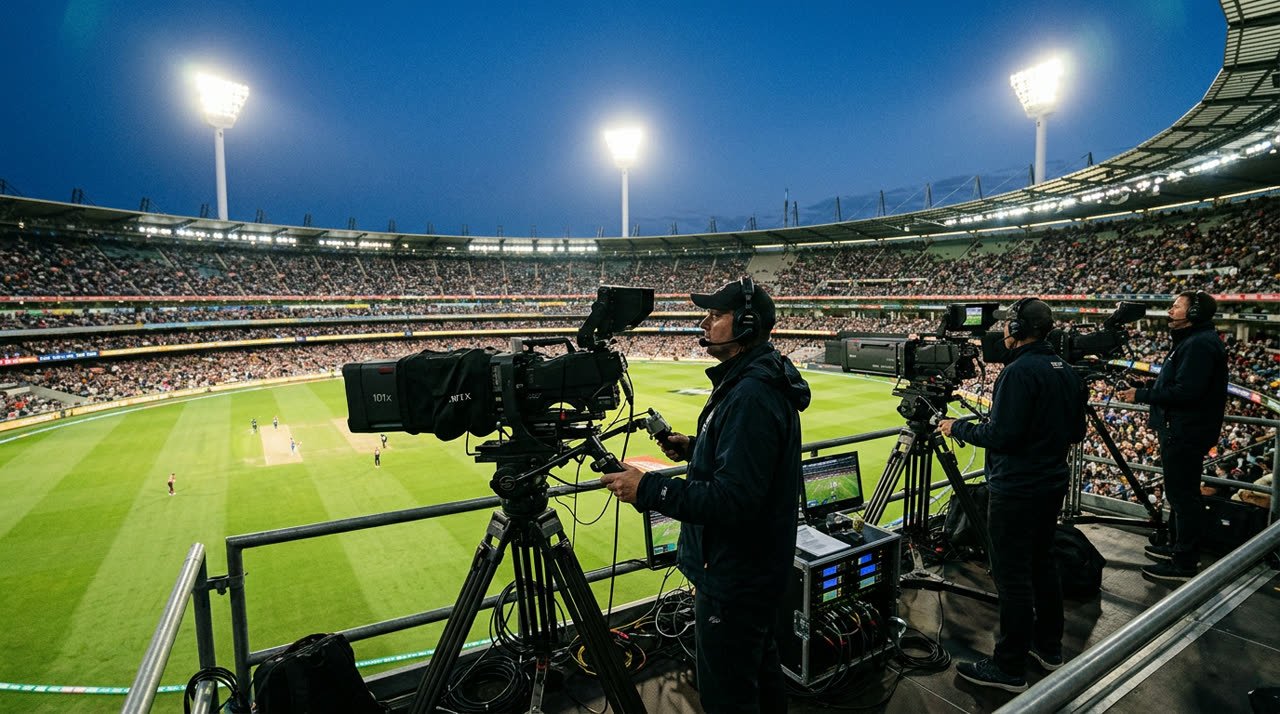
The modern era of cricket broadcasting owes its genesis to an Australian media tycoon named Kerry Packer. In 1977, frustrated by his television network's inability to secure exclusive broadcast rights for Australian home Test matches, Packer established World Series Cricket (WSC). This breakaway tournament disrupted the conservative traditions of the game by treating cricket not merely as a traditional sport, but as prime-time television entertainment.
Packer introduced revolutionary production innovations that have since become standard across global sports broadcasting: colored playing clothing, night matches played under massive stadium floodlights, white leather balls, and critically, an expanded multi-camera production setup. Before WSC, television coverage primarily relied on a single fixed camera positioned high behind the bowler's arm.
By introducing reverse-angle cameras, close-up zoom lenses, and ground-level camera positions, Packer's production crews captured the sheer velocity of fast bowlers and the split-second reaction times required of batsmen for the very first time.
- Introduction of floodlit night matches engineered specifically for prime-time evening television audiences.
- Strategic camera placement at both ends of the stadium to provide dual-perspective tactical analysis.
- High-definition slow-motion replays that revealed pitch behavior and biomechanics in real time.
Micro-Sensors and Aerial Angles: Immersing the Viewer
As broadcast hardware miniaturized through the late 1990s and early 2000s, television directors sought to position the camera closer to the action than physical human operators could ever safely stand. The introduction of stump cameras—tiny lenses mounted directly inside the wood of the middle wicket—offered a terrifying eye-level view of 95 mph fast bowling, while embedded micro-microphones picked up subtle sounds of seam movement, ball impact, and strategic field chatter.
Modern broadcasts expanded into three dimensions with sophisticated aerial engineering. Cable-suspended camera systems, such as Spidercam, hover dynamically above the outfield, dropping viewers right down into a bowler's run-up or swooping high above the pitch to reveal intricate field placements in breathtaking detail. Drones and motorized rail cameras running along the boundary boards now provide fluid, cinematic motion shots that rival big-budget filmmaking, creating an immersive visual narrative that keeps audiences deeply connected to the action.

Demystifying the Invisible: Ball Tracking and Telemetry
Perhaps the most profound shift in cricket broadcasting came with the introduction of real-time telemetry and predictive graphics overlays. Technologies such as Hawk-Eye—originally developed for military missile tracking and ball trajectory calculation—transformed passive television viewing into an analytical deep dive. For the first time, home audiences could visualize the hidden physics of every delivery: spin rotation rates, seam release angles, flight drift through the air, deviation off the pitch, and predicted bounce height.
Graphical audio systems like Snickometer and its modern successor UltraEdge brought soundwave analysis directly to the screen, isolating high-frequency spikes caused when a ball brushed the edge of a bat. Thermal imaging through Hot Spot further illuminated minute points of friction and contact. These innovations did far more than educate the fan on the couch; they established the technical infrastructure for the Decision Review System (DRS), forever linking broadcast technology directly to official match adjudication.
The Economics of the Image: Broadcast Rights as a Global Engine
The visual enhancement of cricket directly fueled an unprecedented economic boom across the global sports market. As the game became more dynamic, understandable, and visually appealing on screen, international media conglomerates recognized its unmatched ability to capture and retain massive audience attention across hours of live programming.
The Indian Premier League (IPL) emerged as the flagship product of this media revolution. By pairing world-class athletic talent with ultra-glossy broadcast values—LED stumps that flash upon impact, heavy soundtrack integration, graphic overlays, and synchronized pyrotechnics—the league built a multi-billion dollar entertainment empire.
Today, media broadcast rights dominate the balance sheets of international cricket boards. These lucrative television and digital streaming contracts dictate international tour schedules, venue selections, match timing windows, and even rule modifications designed to maintain rapid over-rates and optimized commercial breaks.
The Digital Frontier: Interactive Fandom and Second Screens
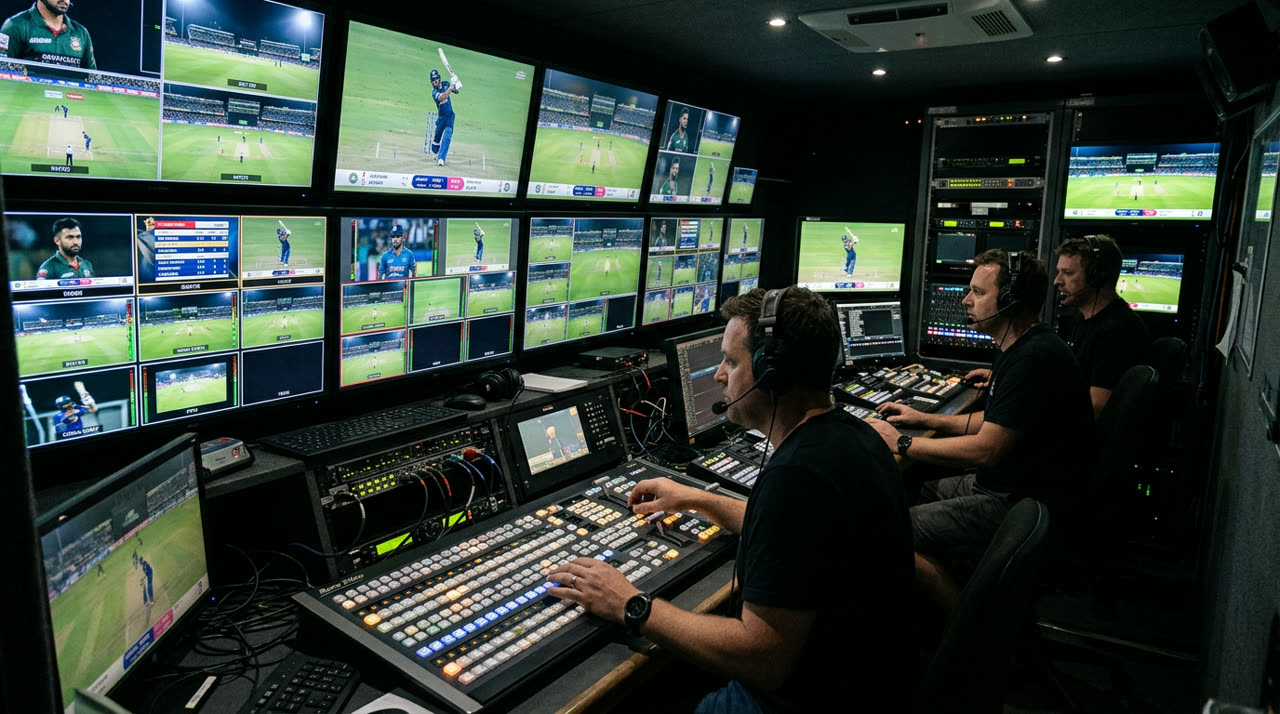
In the digital era, cricket broadcasting is no longer a passive, one-way transmission to a living room television set. Over-the-top (OTT) digital streaming platforms have introduced hyper-personalized broadcast features where users can select their preferred camera feeds, toggle live statistical telemetry, or choose alternative audio commentary tracks in localized languages.
Simultaneously, short-form video clipping and real-time social media distribution have democratized how cricket content moves across the world. High-definition slow-motion reels of athletic boundary catches or timber-shattering yorkers circulate globally within seconds of happening live on the field. This second-screen ecosystem keeps younger audiences engaged with the sport, turning technical tactical battles into viral moments of peak human performance.
From the nostalgic warmth of crackling radio reports to the hyper-real, multi-angle visual spectacles of today, cricket broadcasting has traveled an extraordinary evolutionary path. By embracing optical engineering, predictive data modeling, and cinematic presentation, the media industry did not merely document cricket—it illuminated the hidden nuances of a deeply strategic game for a global audience of billions.
As artificial intelligence graphics, augmented reality overlays, and hyper-personalized streaming feeds continue to mature, the bond between cricket and broadcast technology will grow even stronger. Yet, beneath all the sophisticated telemetry and multi-camera magic, the core appeal of the sport remains beautifully unchanged: a bowler running in, a batsman waiting, and a ball spinning through the air, captured perfectly in the spotlight of the frame.





0 Comments