
For generations, cricket training was notoriously traditional. Practice consisted almost entirely of endless net sessions, basic catching cradles, and long runs around the stadium perimeter. Cricketers trained exclusively for cricket, relying on sport-specific repetition while remaining largely isolated from the training methodologies that were revolutionizing other global sports.
Today, that isolationist mindset is completely dead. As cricket has evolved into an explosive, multi-million-dollar global sport demanding elite athleticism, coaches and sports scientists have unlocked a new frontier: cross-sport synergy. By borrowing mechanics, biomechanics, and tactical philosophies from baseball, golf, track and field, and soccer, modern cricket is undergoing an athletic renaissance that is redefining what players can achieve on the field.

The Death of Cricket Isolationism
The shift toward cross-sport conditioning began when the demands of short-format cricket exposed physical and mechanical limits in traditional players. As T20 leagues accelerated the game's pace, traditional cricket coaching could no longer provide all the answers for hitting ball speeds over 90 mph into the stands or throwing accurately from 80 meters out.
High-performance directors began looking outward to sports that had spent decades perfecting specific physical movements. By analyzing how baseball batters generate torque, how track athletes maximize sprint efficiency, and how golfers transfer ground reaction force, cricket programs began integrating cross-disciplinary coaching into their regular regimes.
- Integration of specialized biomechanists from non-cricket backgrounds.
- Shift from endurance-focused conditioning to high-velocity movement training.
- Adoption of cross-sport technology like high-speed motion capture and force plates.
Baseball's Blueprint: Power Hitting and Outfield Throws
The most obvious cross-sport influence on modern cricket comes from Major League Baseball. For over a century, baseball scientists studied how to launch a ball with maximum exit velocity using rotational power and kinetic sequencing. Modern cricket power-hitting coaches—many of whom have consulted with baseball swing experts—have adapted these exact principles to batting.
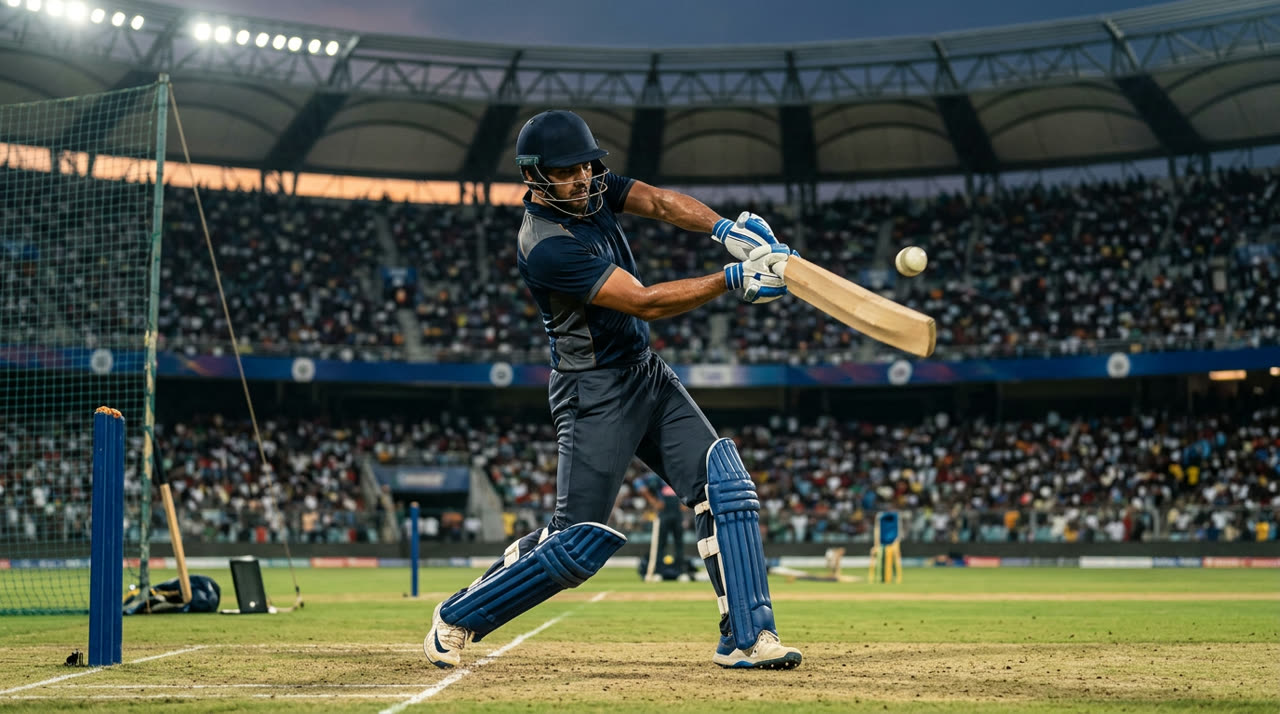
Rather than relying strictly on the traditional top-hand control and classic vertical bat path, modern power hitters utilize baseball-style hip-shoulder separation. By rotating the hips explosive milliseconds before the shoulders and hands, batters create a stretch-shortening cycle in their core muscles. This whip-like motion generates immense bat head speed, enabling clear clearing of boundary ropes even on mis-hit balls.
Similarly, outfield throwers have revolutionized boundary defense by adopting baseball mechanics. The traditional cricket long-throw often placed enormous strain on the shoulder joint while sacrificing velocity. Boundary fielders now practice baseball crow-hops and flat-seam release angles, allowing them to launch flat, 85-plus mph strikes to the wicketkeeper with greater control and lower injury risk.
The Golf Swing Connection: Kinematic Sequencing and Ground Force
While baseball provided the blueprint for rotational power against high pitch locations, golf provided the masterclass in precision weight transfer and ground reaction forces. At first glance, golf and cricket seem light-years apart, but down at the feet and hips, the kinetic transfer required to strike a stationary or moving ball efficiently is remarkably similar.
Biomechanical studies show that elite long-drive golfers and top T20 clearers share almost identical kinematic sequences: energy flows from ground interaction through the feet, into leg extension, across hip rotation, through the torso, and finally out through the arms and bat. Cricket batting coaches now utilize force plates—a tool long standard in elite golf—to measure how players push into the ground during their downswing.
By learning to press firmly into the surface with their front foot just before contact, cricketers can translate linear momentum into rotational torque. This dynamic allows lower-order batters and smaller-framed players to hit distant boundaries without relying purely on upper-body muscle.
Track & Field Precision: Sprint Mechanics and Crease Acceleration
Running between the wickets has historically been coached through trial and error, but modern teams now treat every single run like a sprint event. Track and field coaches are routinely brought into national setups to breaking down sprint mechanics, stride length, and energy expenditure.
A major breakthrough has been the overhaul of turn-around mechanics at the crease. Historically, players decelerated abruptly, turned using whatever foot felt natural, and accelerated back up from a standstill. Sprint coaches analyzed this movement pattern and introduced principles of decelerative braking and low-center-of-gravity pivot turns borrowed from short-track sprinting and agility sports.
By optimizing foot placement during the turn and maintaining a lower center of mass, batsmen can save up to two-tenths of a second on a second or third run. Across a 50-over or 20-over innings, those saved fractions of a second translate directly into extra runs and reduced physical fatigue.
- Drive-phase mechanics applied to the first three steps out of the crease.
- Biomechanical efficiency adjustments to lower strain on hamstrings and calves.
- Optimized deceleration techniques to prevent momentum loss during turns.

Spatial Awareness and Goalkeeping Mechanics
Defensive agility inside the inner ring has borrowed heavily from field hockey, soccer, and handball. Close-in fielders—such as slip catchers, short-leg, and point fielders—require reaction times measured in milliseconds. To sharpen these reflexes, fielding coaches now employ soccer goalkeeping drills and vision-training protocols.
Wicketkeepers, in particular, benefit from soccer goalkeeping insights. The split-step stance—where a keeper makes a micro-hop as the bowler releases the ball—was popularized in tennis and soccer to prepare the nervous system for rapid lateral movement. Today, elite wicketkeepers use this micro-hop to expand their lateral reaching distance, allowing them to dive cleanly for edges that previously would have flown past them.
In the outfield, dynamic fielders draw upon rugby and soccer principles of spatial awareness and angles of pursuit. Fielders no longer just run toward where the ball currently is; they calculate soft curves and closing trajectories to cut off boundaries cleanly while moving at top speed.
The Rise of the Multi-Sport Youth Athlete
This cross-sport evolution is fundamentally changing youth development pathways in major cricket-playing nations. Talent scouts and academy directors increasingly prefer young athletes who grew up playing multiple sports over those who specialized in cricket too early.
Young athletes who spend their childhood playing soccer, tennis, basketball, or rugby develop superior spatial awareness, agility, motor control, and decision-making under stress. When these multi-sport foundations are eventually funneled into specialized cricket coaching around ages 15 or 16, the result is a far more adaptable, robust, and athletic player.
Early sport specialization often leads to overuse injuries and movement stiffness. By encouraging young cricketers to maintain diverse sporting backgrounds, development academies are building a new generation of versatile athletes capable of pushing the physical boundaries of cricket even further.
Cricket is no longer an isolated island in the sporting universe. By breaking down traditional boundaries and embracing the proven scientific principles of baseball, golf, track, and invasion games, cricket has transformed into a showcase of multidisciplinary athletic performance.
As technology continues to bridge the gap between different sports, the evolution of cricket will only accelerate. The modern cricketer is no longer just a skilled craftsman with a bat or ball—they are a complete, high-performance athlete forged by the best ideas from across the global sporting landscape.






0 Comments