
On a clear morning in February 1979, five men boarded a seventeen-foot fishing boat off the coast of Maui, Hawaii, and sailed directly into an unexpected and devastating ocean storm.
Nine years after the Coast Guard abandoned its search, the vessel and a lone crew member's grave were discovered on an uninhabited Pacific atoll thousands of miles away, raising a troubling question: how did the boat get there, and who buried the sailor?
What We Know: The Vanishing Off Maui
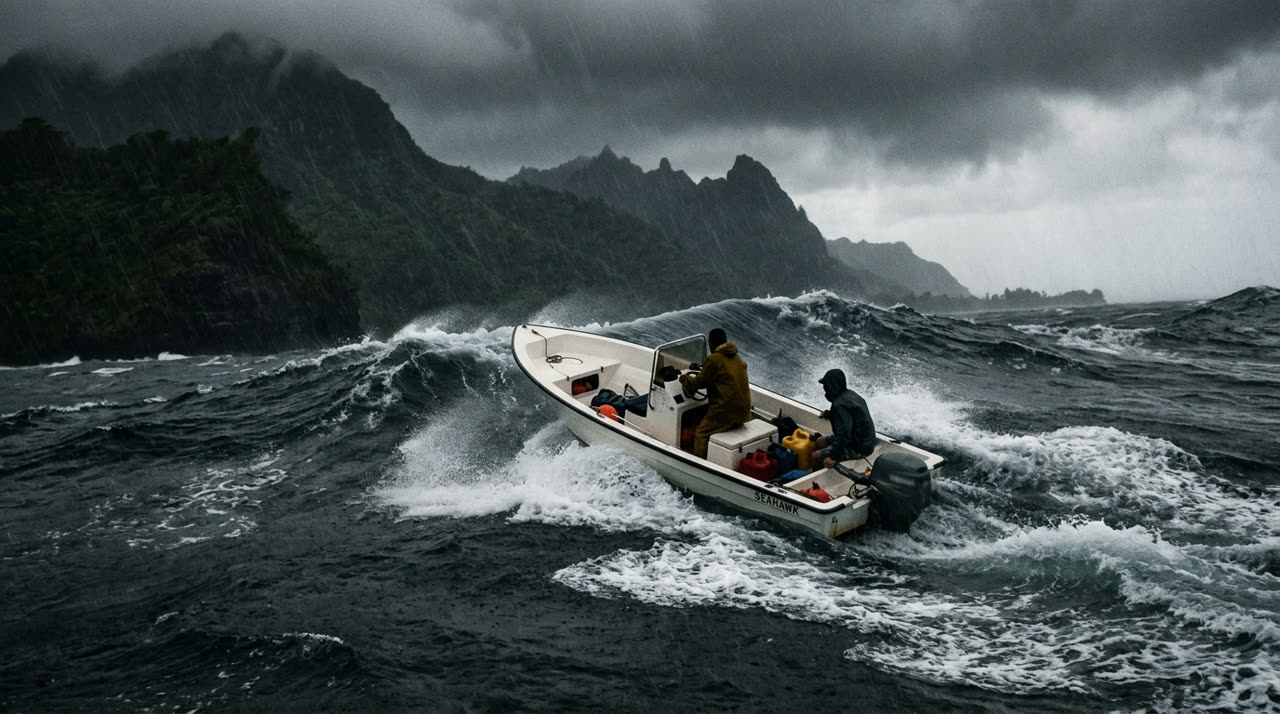
On February 11, 1979, five close friends—Benjamin Haskins, Ralph McNelly, Scott Moorman, Boston Kalama, and Mark Kalama—decided to take advantage of a brief stretch of pleasant weather in Hana, Maui. They launched a seventeen-foot Boston Whaler named the Sarah Joe for a short day trip of coastal fishing. None of the men carried long-range navigation equipment, emergency locator beacons, or extensive survival provisions, as they intended to return to shore by early evening.
Shortly after the Sarah Joe cleared the harbor, a sudden and exceptionally severe storm struck the Hawaiian islands. Local weather forecasters had failed to predict the gale-force winds and heavy squalls that rapidly swept across the water. Dense sea fog and swells topping twenty feet blanketed the waters around Maui, drastically cutting visibility and catching dozens of local boaters off guard. While most nearby vessels managed to return to safety, the Sarah Joe never made it back to port.
The United States Coast Guard immediately launched a massive search and rescue operation that lasted for over a week. Search planes and vessels methodically swept more than 70,000 square miles of the surrounding ocean using radar, visual sweeps, and flight patterns tailored to localized ocean currents. Despite the exhaustive effort, searchers found no wreckage, no oil slicks, no floating debris, and no trace of the missing men.
By late February 1979, official search efforts were formally suspended, and the five fishermen were declared lost at sea. Family members and local residents held memorial services, accepting the tragic probability that the small fiberglass boat had capsized and sunk in deep ocean waters during the height of the storm.
What We Know: The Discovery on Taongi Atoll
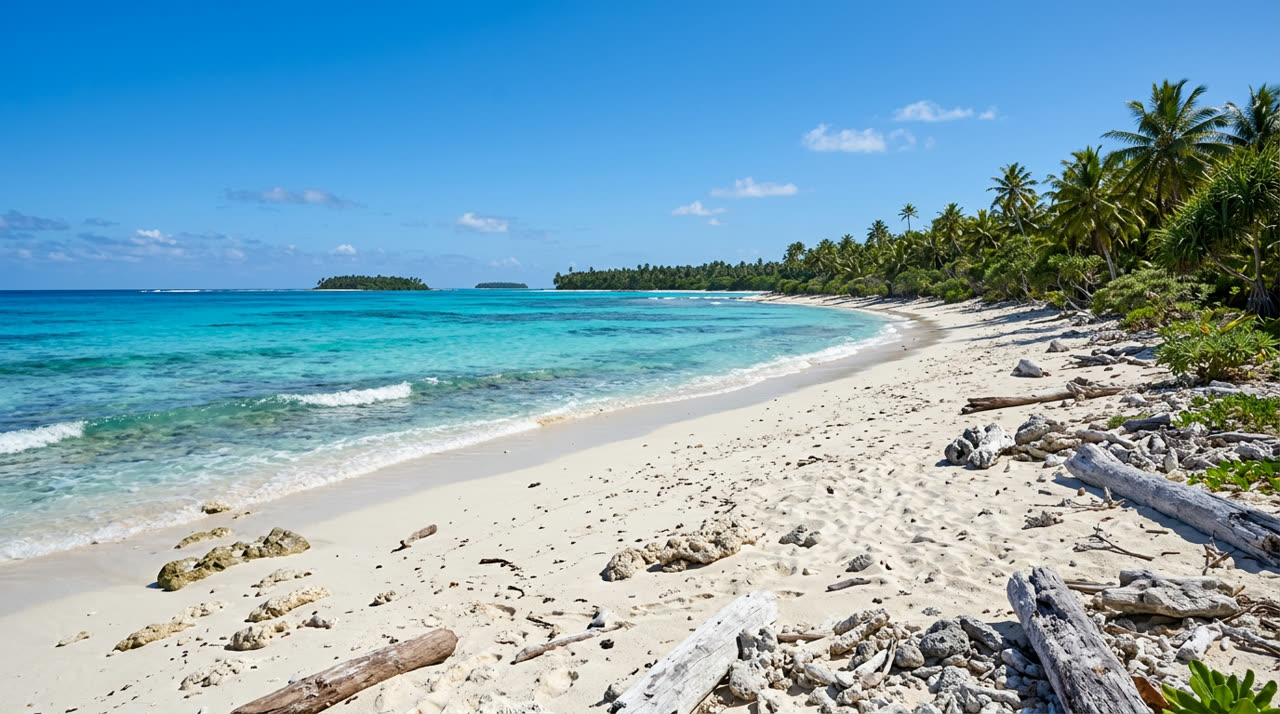
The mystery took a dramatic and unexpected turn on September 10, 1988, more than nine years after the Sarah Joe disappeared. A research team led by marine biologist John Naughton from the National Oceanic and Atmospheric Administration (NOAA) landed on Taongi Atoll, an isolated and completely uninhabited coral atoll in the Marshall Islands. Located approximately 2,200 miles southwest of Hawaii, Taongi is one of the most remote landmasses in the Central Pacific Ocean, rarely visited by commercial ships or local fishermen.
While conducting wildlife surveys on the northern beach of the atoll, Naughton's team stumbled upon a partially buried fiberglass boat hull resting above the high-tide line. The vessel was missing its outboard motor, but the hull remained largely intact despite years of exposure to saltwater and tropical sun. Investigators recorded the registration numbers visible on the bow and cross-referenced them with marine databases. Official records confirmed the vessel was indeed the Sarah Joe.
Near the boat, researchers discovered a simple, human-made burial mound. A shallow grave had been dug into the coral sand and carefully covered with a mound of beach rocks and driftwood. Protruding from the pile of stone were human bones. Standing near the head of the grave were makeshift wooden markers and pieces of weather-worn plastic stuck into the sand, resembling a crude cross or marker.
Subsequent forensic analysis conducted by military laboratories confirmed that the remains belonged to thirty-year-old Scott Moorman, one of the five missing fishermen from Maui. Skeletal examination showed no signs of violent trauma prior to death, indicating that Moorman had died from environmental exposure, starvation, or dehydration long after surviving the initial storm.
What We Know: Timeline Anomalies and Physical Evidence
When forensic experts and oceanographers analyzed the site on Taongi Atoll, they uncovered several physical facts that defied standard explanations. Primary among these was a documented biological survey conducted on Taongi Atoll in 1985—three years before Naughton's discovery. The 1985 expedition team had thoroughly explored the exact same beach where the Sarah Joe was found and reported no boat, no grave, and no human debris anywhere on the island.
This three-year gap created a major puzzle for investigators. If the Sarah Joe drifted across the Pacific immediately after the 1979 storm, it should have arrived at the Marshall Islands within two to three months based on known equatorial ocean currents. Yet physical evidence suggested that the grave had been constructed much later than 1979, and the boat had not been present on the beach during the 1985 wildlife inspection.
Furthermore, the physical construction of Scott Moorman's grave exhibited meticulous care. Layers of foil-backed paper and synthetic cloth had been placed directly over the body before coral stones were stacked on top. Between the sheets of paper were small pieces of yellow plastic cut into precise shapes. This careful arrangement indicated a deliberate burial ritual rather than an emergency disposal of a body by a dying companion.
Despite extensive searches across the entire surface of Taongi Atoll and surrounding reefs, searchers found no remains, clothing, or personal belongings of the other four men—Benjamin Haskins, Ralph McNelly, Boston Kalama, or Mark Kalama. No additional graves or campsites were ever located on the island or on neighboring atolls in the region.
The Theories Behind the Disappearance
Over the decades since the discovery on Taongi Atoll, maritime investigators, oceanographers, and forensic experts have proposed three primary explanations to account for the fate of the Sarah Joe and its crew.
Theory 1: Extended Ocean Drift and Survival at Sea The simplest explanation suggests that the Sarah Joe survived the initial 1979 storm but lost engine power. The small vessel then drifted westward along the North Equatorial Current across thousands of miles of open ocean. Proponents of this theory argue that Scott Moorman survived the grueling ocean voyage, eventually washing ashore on Taongi Atoll. Weakened by months at sea, Moorman may have built a shelter before succumbing to dehydration, with shifting sands later burying his remains until wind uncovered them before 1988. However, this theory fails to explain who crafted the intricate grave markers or why the boat was absent during the 1985 survey.
Theory 2: Burial by Foreign Fishermen A widely discussed theory among investigators posits that foreign fishermen—possibly illegal poachers operating in the protected waters of the Marshall Islands—landed on Taongi Atoll between 1985 and 1988. Upon finding Moorman's preserved body washed ashore alongside the derelict hull, the crew gave him a respectful burial according to traditional customs, using available materials such as boat paper, plastic strips, and beach rocks. To avoid legal prosecution for illegal fishing in foreign territorial waters, the mariners left no written records and never reported the encounter to international authorities.
Theory 3: Rescue and Subsequent Castaway Event Another hypothesis suggests that a passing vessel rescued one or more crew members during or shortly after the 1979 storm. In this scenario, the damaged Sarah Joe was towed or drifted to the Marshall Islands years later, or was kept aboard a ship until being cast adrift near Taongi Atoll. If Moorman died aboard a foreign vessel that lacked proper clearance, the crew might have landed on the uninhabited atoll to bury his body quietly. This would account for the presence of modern paper and plastic in the grave and the total absence of the other four fishermen.
What Remains Unanswered
Decades after the recovery of Scott Moorman's remains, the mystery of the Sarah Joe remains officially unresolved. Investigators still cannot state with certainty when Moorman arrived on Taongi Atoll, how long he survived after departing Maui, or who performed the burial ceremony on the lonely Pacific beach. Most hauntingly, the fate of Benjamin Haskins, Ralph McNelly, Boston Kalama, and Mark Kalama remains completely unknown, leaving their families without closure and leaving one of Hawaii's most enduring maritime mysteries frozen in time.
The story of the Sarah Joe stands as a sobering reminder of the power and unpredictability of the ocean. While modern science solved the question of where one missing fisherman ended up, it unlocked a deeper historical riddle that may never be fully answered. Until new evidence comes to light from sea logs or deep-sea recovery, the full truth of what happened during those long years in the Pacific will remain buried beneath the sands of Taongi Atoll.


0 Comments