
On a clear afternoon in December 1945, five military planes took off from Florida on a standard training flight and never came back. How could five advanced aircraft and 14 experienced airmen completely disappear without leaving behind a single piece of wreckage?
The loss of Flight 19 became one of the most famous aviation mysteries in American history. It triggered one of the largest air and sea searches in military history, yet no trace of the flight or its crew has ever been found.
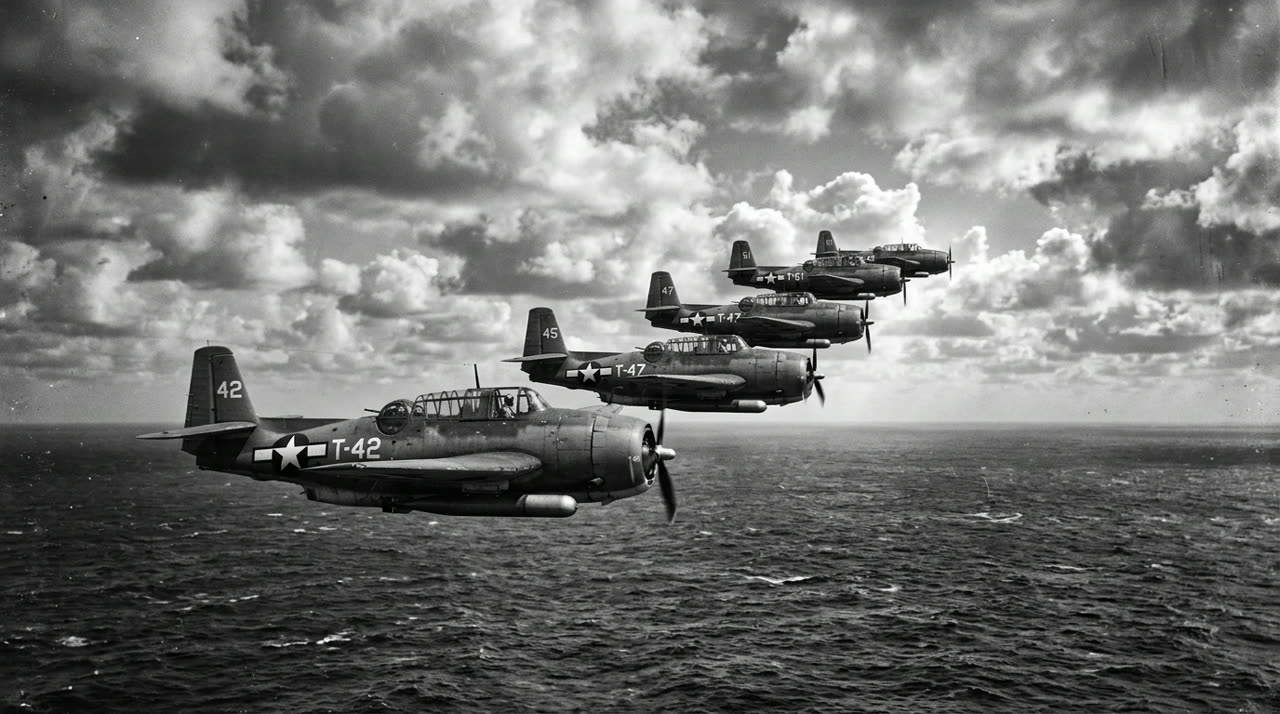
What We Know About the Flight
On December 5, 1945, five TBM Avenger torpedo bombers launched from Naval Air Station Fort Lauderdale in Florida at 2:10 p.m. The flight was led by Lieutenant Charles C. Taylor, an experienced Navy pilot and flight instructor with more than 2,000 hours of flying time. Four of the aircraft held three crew members each, while one plane had only two, bringing the total headcount to 14 airmen.
The five planes set out on a routine three-hour training mission called Navigation Problem No. 1. Their flight plan required them to fly 56 miles east to conduct bombing practice at the Hen and Chickens Shoals, continue east for another 67 miles, head north for 73 miles over Grand Bahama Island, and finally fly southwest back to their base in Fort Lauderdale.
Radio logs reveal that around 3:45 p.m., Lieutenant Taylor reported that both of his aircraft compasses were malfunctioning and that he was unsure of his location. He stated that he believed the squadron was flying over the Florida Keys in the Gulf of Mexico, when in reality they were far out over the Atlantic Ocean. Over the next few hours, base operators attempted to help the flight find its bearings, but worsening weather and radio interference prevented clear communication.
By 7:04 p.m., the airmen were running dangerously low on fuel as darkness fell over the ocean. The final recorded transmission from Flight 19 indicated that the planes were preparing to ditch together into the heavy seas once their fuel ran out completely. Later that evening, a PBM Mariner flying boat sent on a rescue mission also vanished, bringing the total loss that day to six aircraft and 27 men.
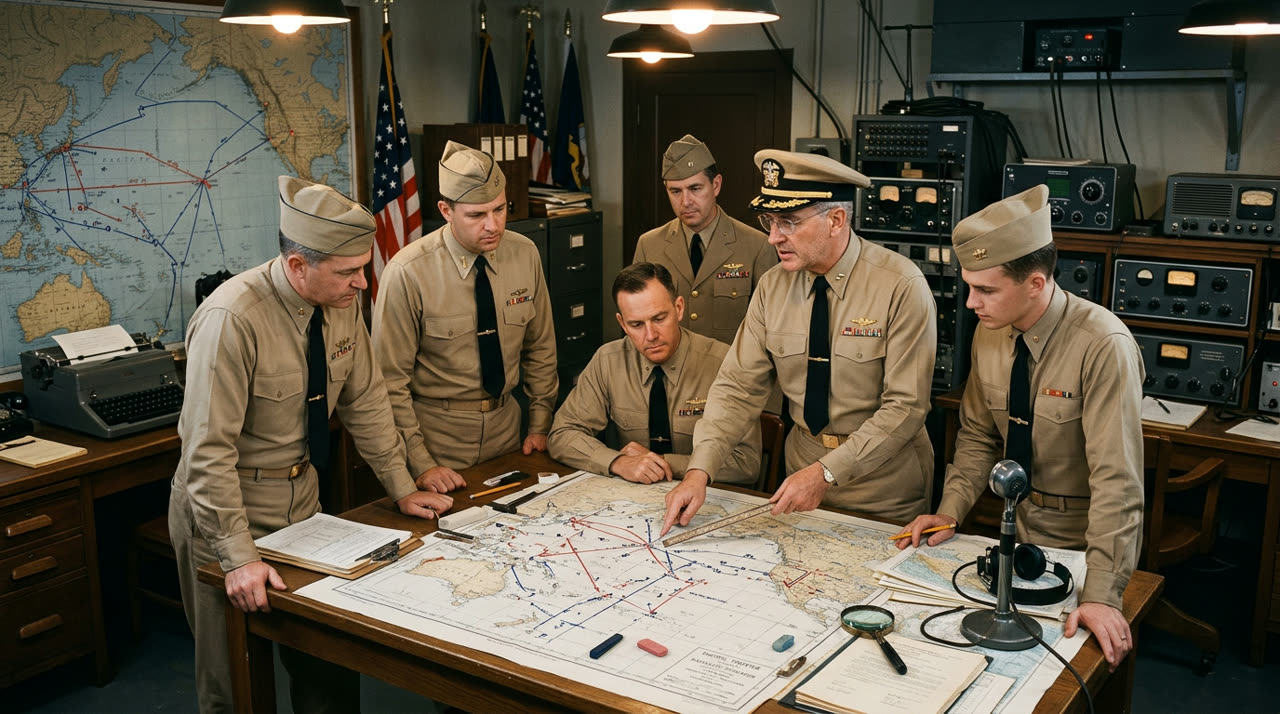
The Official Navy Investigation
Following the disappearance, the U.S. Navy launched a massive search effort using hundreds of ships, submarines, and aircraft to scan more than 250,000 square miles of the Atlantic Ocean and the Gulf of Mexico. Despite several days of intensive searching, search crews found no oil slicks, life rafts, floating debris, or wreckage.
The Navy convened a formal board of inquiry to analyze radio transcripts, witness testimonies, and weather reports from that day. The board's initial 500-page report attributed the accident primarily to pilot error, stating that Lieutenant Taylor had mistaken his location and refused advice to switch radio frequencies.
However, following strong protests from Taylor's family, who pointed out that there was no physical evidence or working equipment left to prove pilot error, the Navy revised its official findings. In 1947, the Navy changed the official cause of the incident to 'causes unknown,' preserving the honor of the lost crew members while leaving the case open.

The Main Theories Behind the Disappearance
Theory 1: Spatial Disorientation and Fuel Exhaustion. The widely accepted scientific explanation is that Lieutenant Taylor suffered from spatial disorientation caused by faulty navigational compasses. Believing he was south of Florida in the Keys, he led his squadron northeast in an attempt to reach the mainland. Instead, this heading carried the five planes deeper into the open Atlantic Ocean until their fuel tanks ran completely empty.
Theory 2: Severe Weather and Ocean Currents. Weather records from December 5, 1945, show that a sudden storm hit the search area after sunset, bringing high winds, rain squalls, and rough seas with waves reaching up to 15 feet. Heavy TBM Avenger bombers were notoriously difficult to land on water, and in complete darkness and high waves, the planes likely broke apart immediately upon impact. Furthermore, the swift Gulf Stream current could easily have swept away floating debris before searchers arrived the next morning.
Theory 3: Catastrophic Malfunction of the Rescue Plane. Regarding the missing PBM Mariner search aircraft, investigators strongly suspect an inflight explosion rather than an unknown ocean anomaly. The Martin Mariner was nicknamed 'the flying gas tank' because it was prone to aviation fuel vapor leaks. A nearby tanker ship, the SS Gaines Mills, reported seeing a bright flash of fire in the sky at 7:50 p.m., followed by an oil slick on the ocean surface, suggesting the search plane exploded in mid-air.
What remains unanswered is where the physical remains of Flight 19 actually rest today. Over the past several decades, deep-sea explorers and marine salvage teams have discovered numerous sunken WWII aircraft in the waters off the coast of Florida, yet none have ever been matched to the serial numbers of the five lost Avengers. Until a piece of wreckage from Flight 19 is positively identified on the ocean floor, the final fate of those 14 young men will remain one of history's greatest unsolved military mysteries.


0 Comments