
For over a century, Test cricket adhered to a timeless rhythm: play began under the morning sun, paused for lunch and tea, and wrapped up as late-afternoon shadows lengthened across the grass. The traditional red ball, white clothing, and natural sunlight formed an unwritten contract between bat and ball. However, as modern entertainment demands pushed cricket administrators to innovate, Day-Night Test matches emerged, forever altering the game's tactical landscape.
Playing red-ball cricket under artificial floodlights was visually impossible, leading to the creation of the pink ball. Yet, what began as an administrative experiment to boost stadium attendance quickly transformed into a complex strategic battlefield. Day-Night Test cricket is not merely regular Test cricket played at night; it is an entirely distinct tactical ecosystem governed by shifting optics, unique ball mechanics, atmospheric transitions, and psychological warfare.

The Pink Ball Imperative: Construction and Mechanics
To understand the tactical depth of Day-Night Test cricket, one must first look at the science behind the pink ball itself. Standard red balls are dyed directly into the leather, while white balls used in short-format cricket receive a thin protective coat. The pink ball, however, presents a unique challenge: it must remain visible against a dark night sky under intense stadium light towers without wearing down too quickly on abrasive pitches.
Manufacturers solved this by applying a heavy layer of clear pigment lacquer over pink-dyed leather. This extra coating drastically changes how the ball behaves on the pitch. Unlike a traditional red ball—which typically swings early, settles down during the middle overs, and later offers reverse swing as one side roughens—the pink ball retains its hard, shiny exterior for a significantly longer period. Consequently, conventional swing can persist far longer, while reverse swing becomes remarkably difficult to generate.
Furthermore, the black synthetic thread used for the seam on many modern pink balls stands out prominently. This raised seam provides fast bowlers with enhanced seam movement off the pitch, making subtle pitch-cutters far more dangerous throughout the innings.
- Heavy Lacquer Coating: Preserves color visibility but alters natural leather degradation.
- Persistent Conventional Swing: The shiny surface keeps the ball swinging longer than a traditional red ball.
- Suppressed Reverse Swing: Smooth outer layers prevent the asymmetric wear needed for classic reverse swing.
- Prominent Synthetic Seam: Offers pronounced movement off the pitch when landing on the seam.
The Dreaded Twilight Zone: The Ultimate Batting Nightmare
In standard Test matches, the session immediately following the lunch break is often considered the ideal time for batting. The sun is at its peak, the pitch has settled, and the ball has lost its initial shine. In Day-Night Test cricket, this dynamic is completely inverted during the transition period known as twilight.
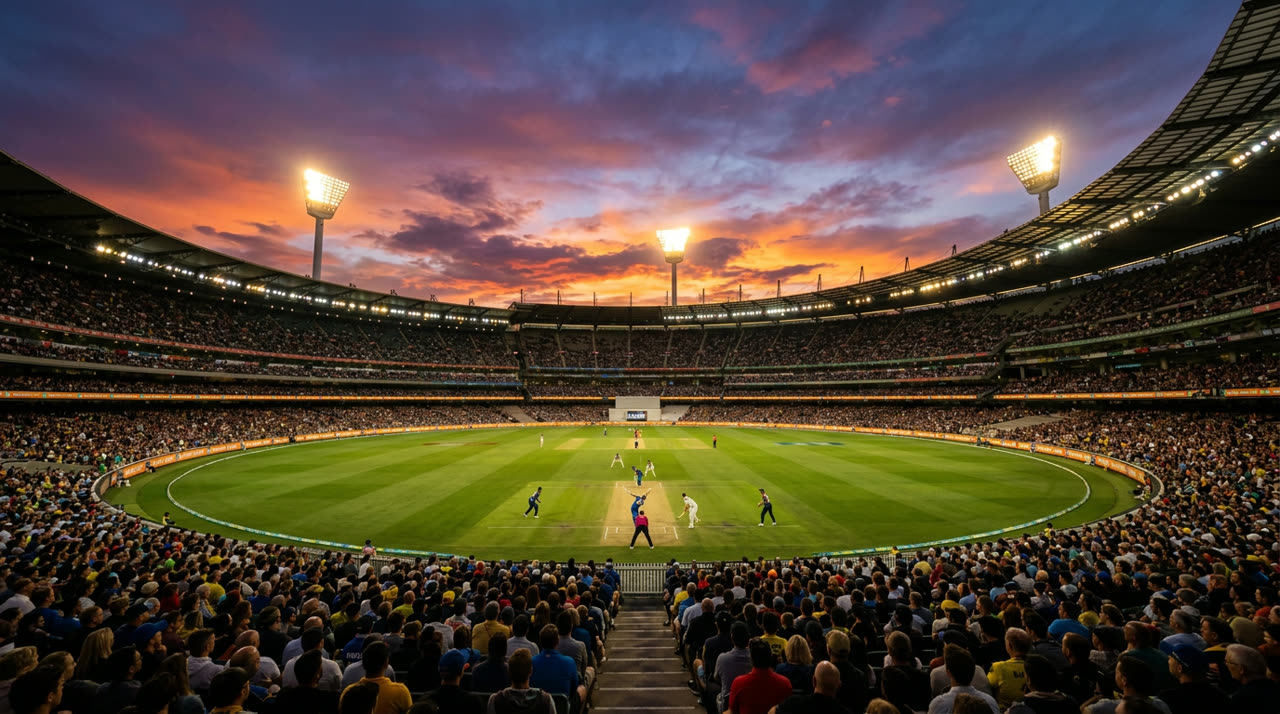
Twilight occurs as the natural sunlight fades and artificial floodlights take full effect. For batters, this 45-to-60-minute window is visual torture. The human eye struggles to adjust rapidly to the mix of ambient natural light and harsh artificial glare. The pink ball, which appears bright pink in full daylight and luminous under pure floodlights, briefly turns a dull, muddy orange during twilight, making depth perception and seam tracking extraordinarily difficult.
Compounding this visual handicap is a natural drop in atmospheric temperature as evening sets in. As ambient temperatures fall, relative humidity rises, causing the air to thicken slightly and creating ideal conditions for sudden, exaggerated swing. Batters who cruised comfortably through the sunny afternoon session suddenly find themselves fighting for survival against a moving ball they can barely pick out of the hand.
Tactical Declarations: Weaponizing the Dusk Trap
The presence of the twilight window has reshaped how captains approach match declarations. Historically, a Test captain declared an innings closed based on two main variables: setting a safe run target and leaving enough time to bowl the opponent out. In Day-Night Tests, a third crucial variable dictates the decision: timing the lighting conditions.
Modern captains now actively calculate their run rates to ensure their opponents are forced to bat precisely as dusk falls. A captain might willingly forfeit 30 or 40 additional safety runs if it means unleashing fresh fast bowlers with a brand-new pink ball during the twilight session.
Conversely, batting captains sitting on a comfortable lead near late afternoon face agonizing strategic choices. Do they push forward aggressively before dusk to declare early, or do they instruct their set batters to drop anchor, play defensively through the twilight horror hour, and save their declaration for the full night session when lighting conditions stabilize? This chess game has produced some of the most thrilling, high-stakes captaincy decisions in modern cricket history.
Dew Management and the Evening Surface Shift
While twilight presents a formidable challenge to batters, the late-night session brings its own set of complications for the fielding side, primarily driven by dew. In many global venues, cool evening air causes moisture to condense on the outfield grass, creating a wet playing surface during the final hours of play.
Dew alters the match in two distinct ways. First, a wet ball acts like a sponge, softening the leather rapidly and deadening the seam. This neutralizes seam movement and makes it difficult for fast bowlers to maintain a firm grip. Second, the wet grass speeds up the outfield while simultaneously rendering spin bowling almost unmanageable, as finger spinners struggle to impart revolution on a slick, waterlogged ball.
Ground staff employ anti-dew chemical sprays and drag heavy ropes across the grass during intervals to mitigate moisture. Meanwhile, tactical teams adapt by rotating their bowling operational plans. Captains will often charge their fast bowlers with taking quick wickets during the early night session before dew sets in, knowing that the final hour of play may devolve into a defensive battle where holding runs becomes the primary goal.

Managing Bowler Workloads Across Temperature Shifts
The physiological demands on fast bowlers in Day-Night Test matches differ significantly from traditional day fixtures. Instead of pushing hard during the scorching midday heat, bowling strategy in pink-ball matches requires careful load management across stark temperature shifts.
Smart teams utilize their spin bowlers strategically during the dry, warm afternoon session. The spinner’s job in the first session is not necessarily to rip through the order, but to hold an end tight, build pressure through maiden overs, and keep the over-rate high. This conserves the physical energy of the pace attack for when atmospheric conditions shift in their favor.
When the temperature drops and dusk arrives, fast bowlers are expected to unleash short, explosive spells at maximum intensity. Instead of long five-over workloads, captains deploy high-impact three-over bursts to exploit the peak swing window. This micro-management of bowler energy ensures that pacers are firing at maximum velocity precisely when the pink ball is behaving most erratically.
Day-Night Test cricket has proven to be far more than a simple broadcasting gimmick. By shifting the schedule into the evening and introducing the pink ball, cricket created a strategic masterpiece that challenges players’ adaptability, vision, and tactical intellect.
From navigating the treacherous twilight hour to calculating time-sensitive declarations, the pink-ball format has breathed fresh energy into Test cricket. As teams around the world continue to refine their approach to these day-night battles, one truth remains clear: mastering the strategy under the lights is now an essential requirement for ultimate success in the modern game.





0 Comments