
In cricket, the defining contest is often framed as a battle between batter, bowler, and the pitch beneath their feet. Yet an unseen fourth contender sits on every field, quietly dictating match dynamics: the earth's atmosphere. From overcast mornings in northern England to muggy evenings in coastal India, environmental variables continuously alter how the ball travels through the air and off the turf.
While casual viewers focus on player form or team selections, elite teams meticulously track barometric pressure, relative humidity, prevailing wind patterns, and dew points. Understanding how these invisible forces shape ball movement, pitch behavior, and athlete fatigue unlocks a far deeper appreciation of cricket's strategic depth.
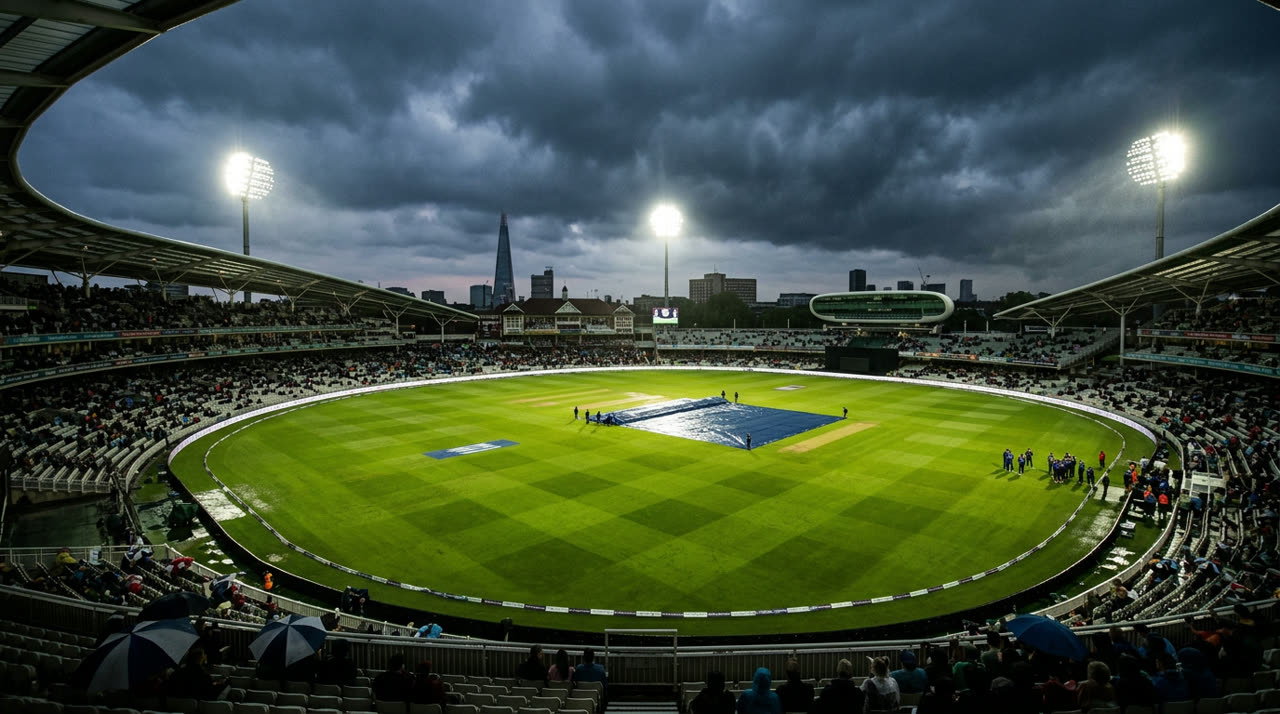
Overhead Conditions and the Physics of Aerial Movement
The traditional cricket adage advice dictates that when the sky is gray, captains should elect to field first. While commentators frequently refer to heavy air assisting fast bowlers, the physical interaction between atmospheric humidity, temperature, and seam movement is intricate.
Moisture in the air does not physically drag the ball sideways through weight; rather, high humidity and low solar radiation help preserve the leather's natural moisture. This prevents the ball from drying out quickly, allowing the raised seam to retain its pronounced ridge for a longer duration. Furthermore, cloud cover stabilizes air temperatures near the ground, reducing thermal turbulence and allowing smooth laminar airflow across the ball's polished surface.
When a seam bowler releases a delivery into cool, damp air, the boundary layer of air surrounding the ball shifts predictably, producing late, sharp swing. Conversely, dry heat speeds up leather deterioration and creates erratic airflow, shortening the window in which conventional swing remains effective.
- Cooler, denser air preserves seam shape and enhances directional swing duration.
- Direct sunlight speeds up leather drying, shifting conditions toward seam resistance rather than atmospheric swing.
- Stable thermal conditions under cloud cover minimize air turbulence, keeping aerial movement consistent.
The Dew Factor: Night Cricket’s Strategic Disrupter
In white-ball cricket played under lights, few environmental elements wield as much destructive power as dew. As ambient temperatures drop below the dew point after sunset, water vapor condenses rapidly onto grass blades, transforming a firm outfield into a slick, saturated surface.
For the team bowling second, heavy dew creates severe tactical disadvantages. The match ball absorbs moisture from the grass, becoming heavy, slick, and difficult to grip. Spinners lose the friction required to impart seam rotation, causing the ball to skid straight off the pitch without turning. Fast bowlers struggle to maintain firm footing during their stride, while seam movement drops to near zero as the wet leather glides effortlessly across the surface.
Captains anticipating heavy dew routinely opt to bowl first upon winning the toss, choosing to set targets in dry conditions and chase when the wet outfield renders defending small totals virtually impossible.
- Slick outfields eliminate pitch friction, making spin bowling far less effective.
- Wet balls become heavier, reducing maximum speed and trajectory control for seam bowlers.
- Teams utilize chemical anti-dew sprays, heavy towels, and dry-ball practice drills to mitigate moisture impacts.

Wind Vectors: Exploiting Airflow for Tactical Advantage
Wind is rarely a passive background element in cricket; it is a vector that smart captains and skilled bowlers turn into an offensive tool. The direction and velocity of wind across an open stadium fundamentally reshape boundary dimensions and flight trajectories.
Bowlers operate with distinct responsibilities depending on whether they bowl into the breeze or downwind. A leg-spinner bowling into a strong headwind achieves enhanced flight and prolonged drift, as the opposing air force holds the ball up in the air longer, deceiving batters in flight. Conversely, fast bowlers utilizing a tailwind gain additional momentum in their run-up and extra pace through the air.
From a batting perspective, wind vectors dictate power-hitting target zones. Smart batters target the downwind boundary, knowing that even mis-timed lofted shots can carry over the rope when carried by strong tailwinds.
Altitude and Air Density: Cricket at High Elevation
When cricket is played at high altitudes, thin air drastically alters the physics of the game. Venues situated hundreds of meters above sea level feature lower atmospheric density, meaning there are fewer air molecules to create aerodynamic drag against a moving ball.
As a result, hits that would comfortably fall into the hands of deep fielders at sea level sail several rows into the crowd at elevated grounds. Power-hitting metrics skyrocket at high-altitude venues, forcing captains to alter field placements and push boundaries back to maximum limits.
However, thin air presents severe challenges for swing bowlers. Without adequate air density to generate pressure differences across the ball's surface, conventional swing diminishes significantly. Bowlers must rely instead on seam movement off the pitch, raw pace, and sharp variation in length to contain scoring rates.

Light Shifts, Twilight Shadows, and Visual Perception
Atmospheric conditions also control the visual field through which batters track deliveries traveling at high speeds. Natural daylight transitions create subtle windows of extreme vulnerability, nowhere more evident than during the twilight phase of day-night Test matches.
As natural sunlight fades and artificial floodlights take full effect, the pink ball undergoes a visual shift. The contrast against the green turf changes rapidly, making depth perception and seam tracking extraordinarily difficult for batters during this twenty-to-thirty-minute window.
Furthermore, low solar angles during early spring or late autumn fixtures cast long, jarring shadows across the pitch, disrupting sightlines and forcing fielders to adjust to glaring reflections off stadium infrastructure.
Environmental Adaptation and Strategic Horizon
As global weather patterns become more volatile, cricket operations are adapting swiftly to manage extreme heat, unexpected humidity spikes, and intense rain delays. Sports scientists now track wet-bulb globe temperatures to monitor player heat stress, introducing strict micro-hydration protocols during matches played in tropical environments.
Stadium architects are integrating advanced sub-surface aeration systems capable of draining thousands of liters of rainwater in minutes, ensuring matches resume quickly after sudden downpours without altering pitch moisture balances.
Tactical preparation has similarly evolved. Modern teams cross-reference historical meteorological data for venues before selecting their final playing XI, matching player capabilities directly with projected humidity levels, wind vectors, and twilight timing.
Cricket remains one of the world's most atmospheric outdoor sports, deeply tied to the fluid environment in which it is played. The game is never played in a vacuum; every breath of wind, shift in humidity, and drop in temperature leaves an imprint on the outcome.
By recognizing these atmospheric levers, fans gain a richer insight into why captains make seemingly unconventional toss decisions or why elite bowlers change their tactics mid-spell. The invisible opponent is always present, rewarding the teams that respect and adapt to its subtle influence.


0 Comments