
On a cold, rainy evening in 1971, a quiet man boarded a plane in Oregon, hijacked it using a briefcase bomb threat, and leaped into the night with $200,000 in cash. How did a man completely vanish into the dense wilderness of the Pacific Northwest without leaving a clear trace behind?
What We Know: The Hijacking of Flight 305
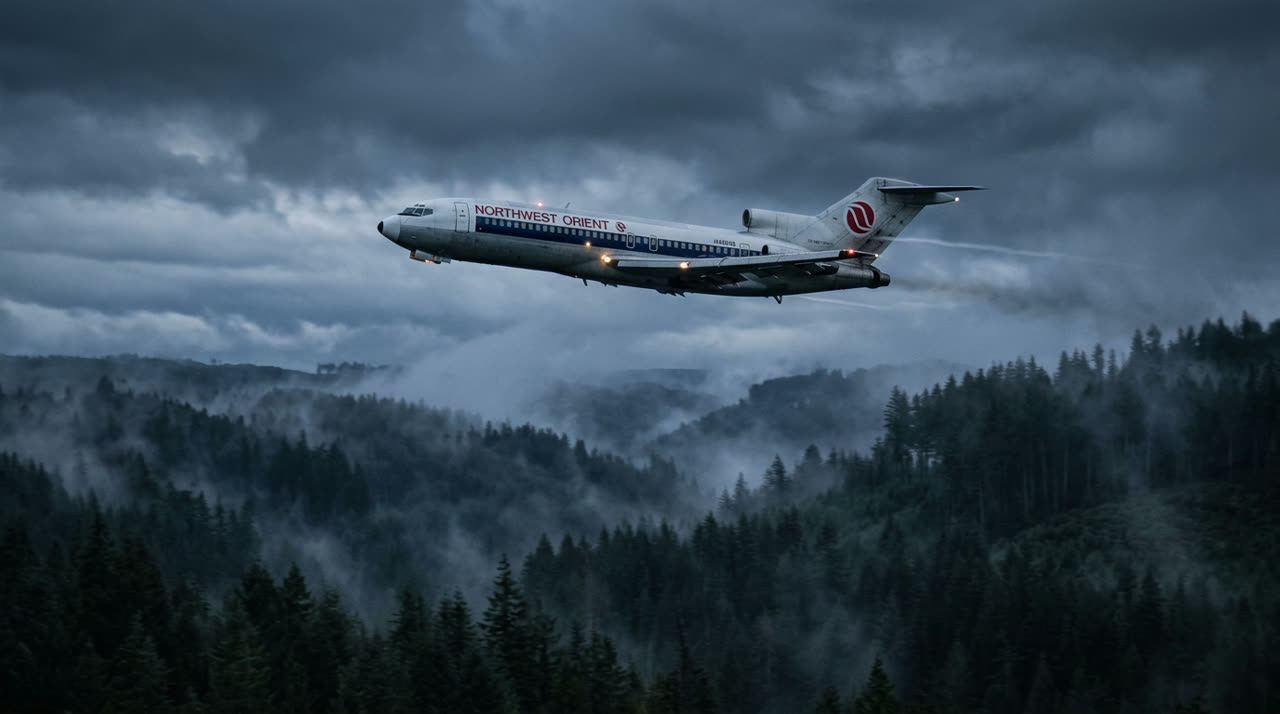
On November 24, 1971, a man calling himself Dan Cooper bought a $20 one-way ticket from Portland, Oregon, to Seattle, Washington, on Northwest Orient Airlines Flight 305. Shortly after takeoff, he handed a flight attendant a handwritten note stating he had a bomb in his briefcase. He demanded $200,000 in negotiable twenty-dollar bills and four parachutes.
When the plane landed in Seattle, Cooper allowed all 36 passengers and two flight attendants to leave safely. In exchange, officials handed over the money and the requested parachutes. The plane was refueled and ordered to fly toward Reno, Nevada, at a low altitude and slow speed.
Sometime around 8:00 PM, while flying through a heavy rainstorm over southwestern Washington state, Cooper lowered the rear stairs of the Boeing 727. He stepped out into the freezing night sky and disappeared into the vast forest below.
In 1980, a young boy vacationing with his family along the Columbia River near Vancouver, Washington, found a rotting bundle of twenty-dollar bills buried in the sand. The FBI confirmed the serial numbers matched the ransom money given to Cooper, totaling $5,800. No other trace of the money or the jumper has ever been recovered.

The Theories: Did He Survive the Jump?
Theory 1: He died during the parachute jump. Many FBI agents and aviation experts believe Cooper did not survive his plunge. He jumped into night conditions with wind chill temperatures well below zero, wearing only a light trench coat, a business suit, and dress shoes. Furthermore, he used a parachute that could not be steered, dropping into dense evergreen forests and rugged terrain in total darkness.
Theory 2: He survived and lived under a fake identity. Proponents of this theory point out that Cooper displayed calm confidence and appeared knowledgeable about aircraft and local geography. If he landed safely near a road or had a secret helper waiting, he could have escaped the search area before law enforcement set up roadblocks.
The Theories: Who Was the Mysterious Skyjacker?
Theory 1: He was an experienced military veteran. Investigators suspected the skyjacker had military training due to his familiarity with parachutes, flight paths, and calm demeanor during high stress. Over the decades, researchers suggested several former military parachutists and skydivers, though none were conclusively linked by physical evidence.
Theory 2: He was a rogue aviation worker. Another popular explanation is that Cooper worked in the commercial aviation industry. His specific knowledge of the Boeing 727's unique rear stairs and fuel requirements led investigators to suspect he was an insider who lost his job during industry cutbacks in the early 1970s.

What Remains Unanswered
In July 2016, after 45 years of active investigation, the FBI officially suspended its active investigation into the case, code-named NORJAK. Thousands of leads were evaluated, but no primary suspect was ever definitively matched to the DNA recovered from Cooper's abandoned clip-on tie. Who Dan Cooper truly was, why he pulled off the daredevil heist, and where his remains or the rest of the ransom money ended up stay among the greatest unsolved mysteries in aviation history.
The story of D.B. Cooper continues to fascinate millions because it stands as the only unsolved skyjacking in commercial aviation history. Until new physical evidence emerges from the Pacific Northwest woods, the identity of the world's most famous skyjacker will remain hidden in the dark.



0 Comments