
While cricket fans meticulously analyze batting technique, bowling speeds, and strategic field placements, the single most decisive variable in any cricket match often sits silently beneath the players' boots. The pitch is cricket’s canvas—a living, breathing surface that changes continuously throughout a match, dramatically dictating how the ball behaves.
Unlike almost every other global team sport played on standardized, uniform fields, cricket is uniquely governed by local agronomy. The unsung architects of these battlegrounds are groundsmanship teams and pitch curators, who blend soil science, fluid dynamics, and meteorology to shape the tempo, balance, and final outcome of the game.
The Chemical Foundation: Clay, Silt, and Sand Dynamics
At the heart of every pitch's distinct personality lies its physical soil composition. A cricket pitch is far more than mere dirt; it is a carefully engineered blend of clay, silt, and fine sand. The balance of these three elements determines how hard the surface can become and how efficiently it transfers kinetic energy back into the ball upon impact.
High-clay soils—typically containing over 40% swelling clay minerals like smectite or illite—are the prized foundation for fast, bouncy pitches. When heavy clay dries out under compression, its microscopic plate-like particles lock together into a dense, brick-like matrix. This extreme hardness prevents the ball's energy from absorbing into the ground, resulting in steep bounce and high carry to the wicketkeeper. Conversely, soils high in silt or sand cannot form strong bonds, producing soft, slow surfaces where the ball loses speed instantly upon landing.
- High-Clay Soil: Yields steep bounce, fast pace, and structural longevity (e.g., Perth, Brisbane).
- High-Silt Soil: Tends to crumble quickly, creating abrasive surfaces that favor early spin and low bounce.
- High-Sand Soil: Absorbs impact energy, producing slow, lifeless pitches that favor patient batting.
The Moisture Dial: Rolling and Dehydration Dynamics
Moisture management is the curator's primary instrument of influence. Water acts as a structural lubricant within the soil profile. Too much moisture makes the pitch soft, producing deep indentations and unpredictable damp seam movement; too little moisture leads to premature crumbling and dusty conditions.
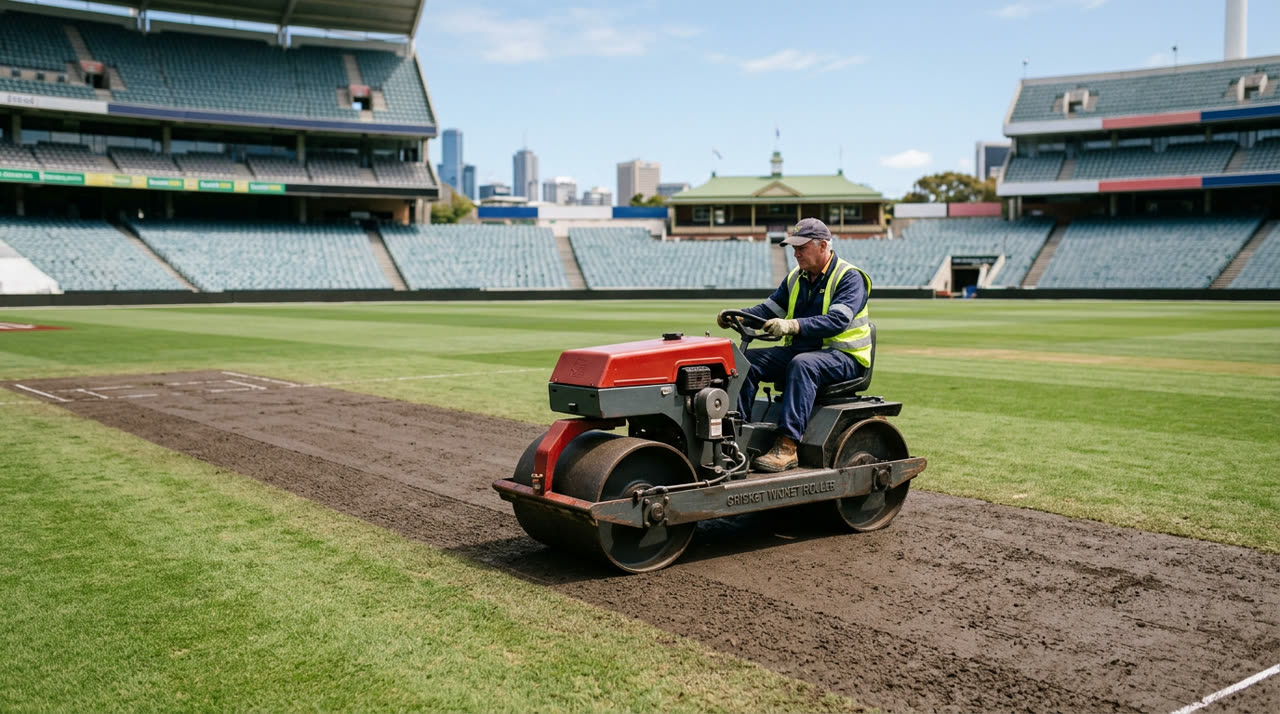
The art of pitch preparation relies heavily on controlled compaction and evaporation using heavy rollers. Rolling a pitch does not merely level the grass; it squeezes residual air pockets out of the topsoil and draws capillary moisture up from deeper sub-layers to the surface, where it evaporates under sunlight. Curators must time their rolling perfectly—compressing the pitch when the moisture level is at a precise threshold causes the clay particles to fuse into a rock-hard upper crust. Rolling a pitch that is too wet destroys its structural integrity, while rolling a dry pitch achieves virtually nothing.
Grass Density and Seam Movement: Crafting the Green Top
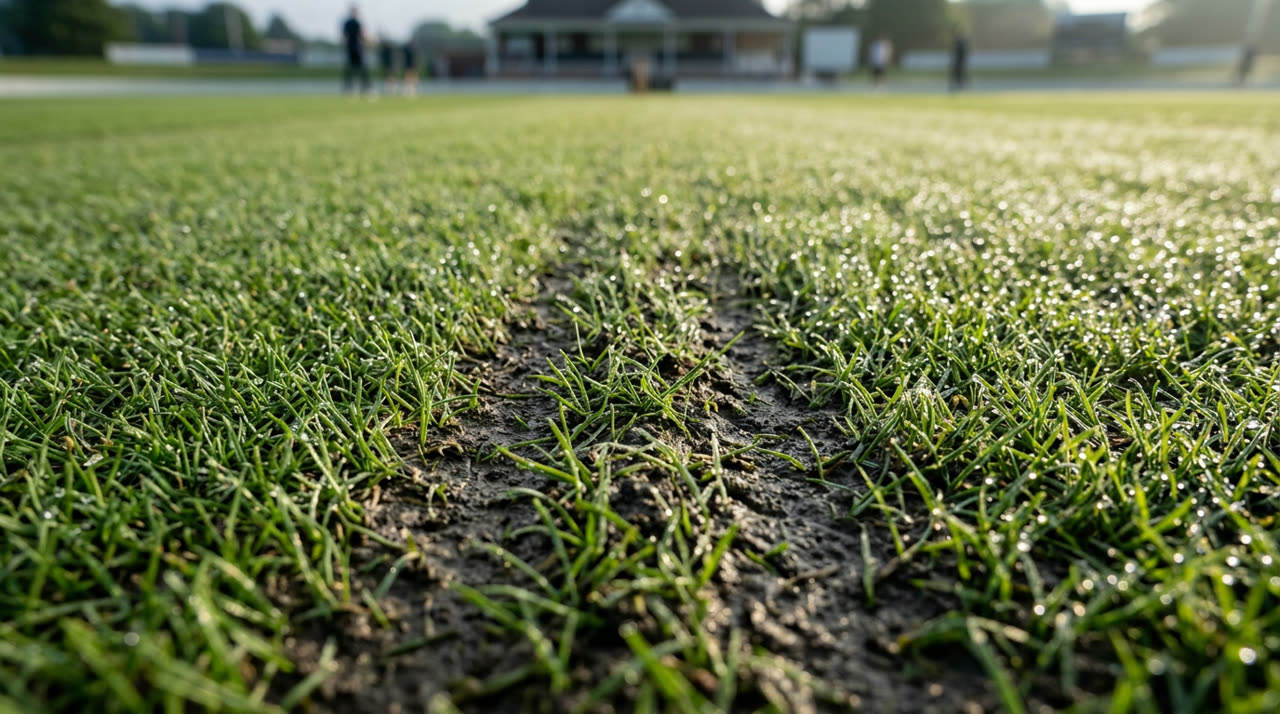
The density, length, and species of vegetation left on a pitch heavily dictate match dynamics, particularly during the early overs of an innings. Grass roots serve a dual purpose: they act as microscopic structural rebar holding the topsoil together, delaying physical surface breakdown, while the living blades on top dictate seam behavior.
When a seam bowler lands the ball on a pitch with significant grass cover—commonly known as a 'green top'—the raised seam of the ball grips the pliable plant leaves upon impact. This friction causes the ball to deviate sideways unpredictably off the surface. Furthermore, natural moisture retained within living grass acts as a lubricant, allowing the ball to skid through quickly without losing momentum. As solar heat bakes the pitch over consecutive days, the grass dries out and wears away, transitioning the pitch from a bowler's paradise into a flatter, easier track for batters.
Wear, Cracks, and Abrasions: The Five-Day Lifecycle
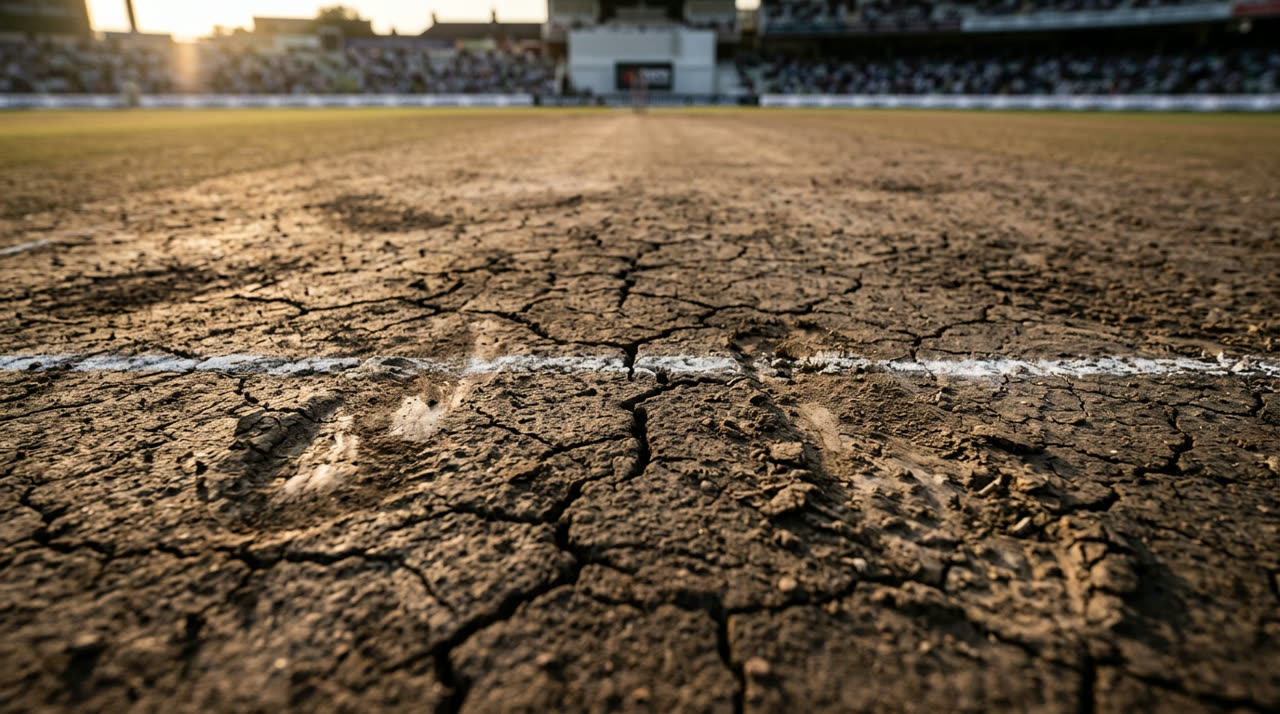
In long-form cricket, a pitch undergoes a dramatic physical transformation across five days. As bowlers land heavily in their delivery strides and batters dig their studs into the crease, the structural integrity of the surface inevitably deteriorates. Bowlers' footmarks carve out rough, exposed patches of pulverized dry clay on either side of the wicket line.
Simultaneously, relentless solar heat causes the clay within the soil matrix to lose moisture and contract, creating deep fissures and surface cracks. When spin bowlers land the ball inside these footmarks or surface cracks, the uneven side-friction grips the ball's leather, producing sharp, unexpected turn and erratic bounce. Captains who win the toss must accurately predict this lifecycle, weighing the benefit of batting early on a smooth track against the extreme difficulty of chasing a target on a crumbling Day 5 surface.
- Days 1–2: Structural stability, slight surface moisture, true bounce, and movement for seamers.
- Days 3–4: Maximum surface hardness, optimal for batting as moisture fully evaporates.
- Day 5: Severe surface abrasion, deep cracks, rough footmarks, extreme spin, and variable bounce.
Curator Autonomy vs. Tactical Home Advantage
Pitch curation sits squarely at the crossroads of natural agronomy and international sporting tactics. Host nations naturally seek pitch conditions that align with their team's inherent tactical strengths—whether that means producing high-bounce lightning tracks for a pace-heavy attack or dry, low-bounce turners for elite spin specialists.
However, curators face complex professional challenges. While home cricket boards may express broad preferences, pitch preparation remains governed by strict international guidelines. If a curator over-prepares a pitch in pursuit of extreme home advantage, the surface risks crumbling prematurely or presenting dangerous, erratic bounce. Such pitches face severe sanctions and negative ratings from governing bodies. Crafting a pitch that offers an equitable contest between bat and ball while lasting the full duration of a match requires immense professional courage and scientific skill.
The Modern Frontier: Hybrid Surfaces and Drop-in Technology
The growth of multi-sport stadiums and increasingly congested cricket calendars has forced groundsmanship into an era of high-tech innovation. Drop-in pitches—constructed in off-site nurseries inside giant concrete or steel trays months in advance—are routinely transported into multi-use arenas via specialized cranes. This technology allows dual-purpose stadiums to host major concerts or football codes during winter, then seamlessly transition into world-class cricket venues for summer.
More recently, hybrid pitch technology has emerged as a game-changer. By weaving synthetic micro-fibers into natural grass and clay soil (accounting for roughly 5% of the surface area), pitch engineers can dramatically improve structural durability. These reinforced surfaces maintain structural firmness under heavy usage, allowing venues to host multiple high-intensity T20 matches back-to-back without the pitch deteriorating into an unplayable track.
Cricket stands apart from almost all global sports because its field of play is not a static background, but an active, evolving participant in every contest. Behind every memorable hundred and every match-winning bowling spell lies the intricate science of groundsmanship teams working in tandem with soil, moisture, and sunlight.
As modern turf technology continues to evolve alongside shifting climate patterns, the role of the pitch curator will only grow more central to the sport. Understanding the delicate agronomy beneath the wickets enriches our appreciation of the game, proving that in cricket, match outcomes are often crafted long before the opening ball is delivered.





0 Comments