
For over a century, the sight of a cricket ball curving sharply through the air has captivated spectators and terrified batters. Swing bowling is often spoken of in poetic terms—a delicate blend of wrist position, atmospheric magic, and seam orientation. Yet behind every late-curving delivery lies a sophisticated interplay of fluid dynamics, air density, and surface roughness.
To truly appreciate the art of fast bowling, one must look past the folklore and examine the physics governing a sphere moving through the atmosphere. From the classic conventional swing seen under damp morning skies to the terrifying, late-tailing phenomenon of reverse swing on abrasive subcontinental pitches, the ball's movement is driven by strict scientific principles. Here is how fast bowlers manipulate physical laws to master cricket's most lethal craft.
The Physics of Conventional Swing: Laminar vs. Turbulent Flow
Conventional swing relies on creating a pressure differential between the two sides of the cricket ball as it travels through the air. When a new ball is bowled with the seam angled slightly toward the slips or leg slip, air flows smoothly over the polished front surface of the ball. This smooth, ordered movement of air is known as laminar flow.
As the air moves along the ball, it encounters the raised central seam. The seam acts as a physical obstacle, tripping the air layer on that side and transforming it into turbulent flow—a chaotic, energetic swirl of air. Turbulent air clings to the surface of the ball longer before detaching, whereas smooth laminar air on the opposite side separates much earlier.
Because the air remains attached longer on the seam-angled side, a localized low-pressure zone is created on that half of the ball. The higher pressure on the opposite side pushes the ball sideways toward the lower pressure, causing it to curve in flight.
- Laminar Flow: Smooth airflow over the polished side of the ball, detaching early.
- Turbulent Flow: Disrupted, high-energy air triggered by the seam, remaining attached longer.
- Pressure Differential: The sideways force created as high pressure pushes toward low pressure.

Crossing the Boundary Layer: How Reverse Swing Works
For decades, reverse swing was viewed as a shadowy, almost mystical skill mastered on the hot pitches of South Asia. In reality, reverse swing is simply aerodynamic physics operating under a different set of extreme boundary conditions. While conventional swing moves the ball toward the rough side (or angled seam side), reverse swing makes the ball curve unexpectedly toward the smooth side.
This phenomenon occurs when the ball becomes heavily aged and scuffed, and the bowler delivers it at high velocity—typically above 85 miles per hour (137 km/h). At these speeds and surface roughness levels, the air flowing over the rough side becomes turbulent almost immediately upon impact, even before reaching the seam.
Meanwhile, the air flowing over the remaining smooth side travels as laminar flow until it hits the seam, where it trips into turbulence. Crucially, this late-formed turbulence on the smooth side stays attached to the surface longer than the prematurely detached turbulent air on the heavily scuffed side. The pressure equation flips completely, pulling the ball hard toward the smooth hemisphere.
The Modern Frontier: Contrast Swing and Seam Position
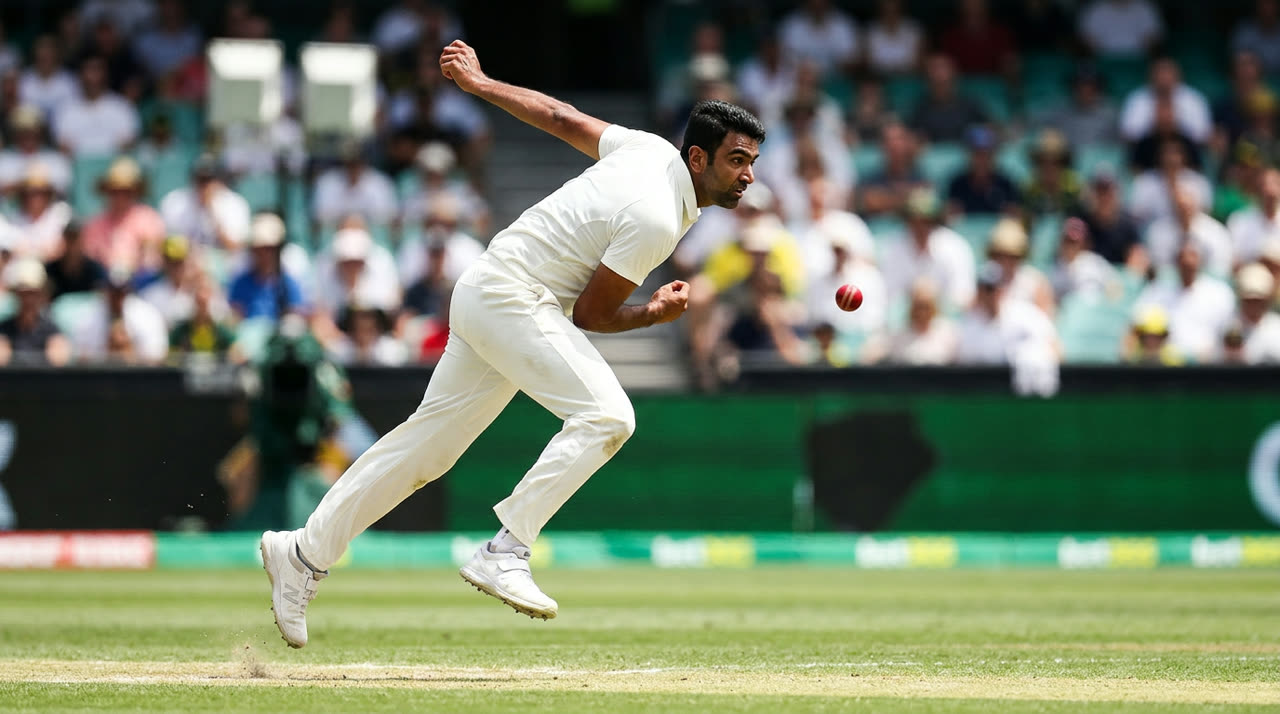
In modern cricket, pitches often lack the abrasive quality required for traditional reverse swing, and modern balls may lose their shine rapidly. Enter contrast swing—a technique designed to generate late movement without relying on an angled seam or heavy pitch wear.
To achieve contrast swing, a bowler releases the ball with the seam pointing directly straight down the pitch, rather than angled toward the slips. One side of the ball is kept impeccably smooth and polished, while the other side is allowed to naturally roughen from impact with the pitch.
Because the seam is straight, it does not act as the primary turbulent trigger. Instead, the contrast in surface texture alone creates laminar flow on the smooth side and turbulent flow on the rough side. This produces late, subtle deviation that occurs much closer to the batter, giving them far less time to read the ball's trajectory off the hand.
Atmospheric Variables: Overhead Conditions vs. Atmospheric Physics
Cricket commentators frequently talk about overcast conditions being 'ideal for swing,' but scientists and aerodynamicists have long debated why cloud cover affects ball movement. Popular theory held that humid, heavy air helped the ball swing more, but fluid dynamics proves that moist air is actually less dense than dry air.
The real relationship between weather and swing lies in temperature gradients, wind turbulence, and surface moisture. Cloud cover prevents solar radiation from heating the ground, minimizing the warm thermal updrafts that normally create turbulent atmospheric currents near the pitch. In calm, cooler air, the microscopic boundary layers on the ball remain stable and undisturbed.
Additionally, grass on the pitch retains moisture longer under cloud cover. Moisture preserves the shine on the polished side of the ball by reducing abrasive friction when the ball bounces, allowing conventional swing conditions to last significantly longer into an innings.
Ball Maintenance: The Art of Preserving Aerodynamic Equilibrium
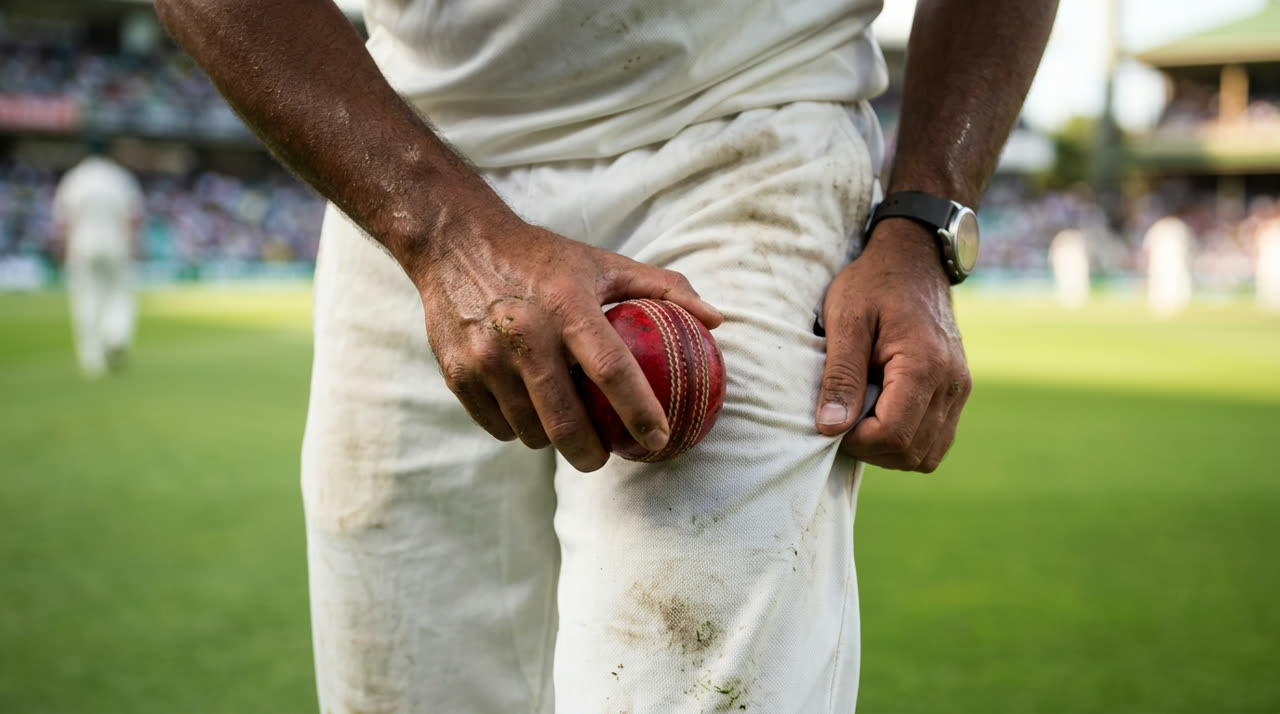
Because swing is dictated by surface symmetry and contrast, ball maintenance is one of the most critical tactical duties on a cricket field. Teams assign designated 'ball caretakers'—usually fielders who wear clean trousers free from abrasive zips or heavy dirt—to manage the ball between deliveries.
The objective is strict: keep one half of the leather completely dry, clean, and polished using natural sweat and physical rubbing, while allowing the opposite half to dry out and absorb impact scuffs. If both sides become equally rough, or if moisture affects the scuffed side, the pressure differential collapses, and the ball goes 'dead' in the air.
Recent regulatory changes, such as the global ban on using saliva to shine the ball, have forced bowlers to adapt. Players now rely exclusively on sweat and cloth friction, requiring precise sweat management and strategic field placement to ensure the ball's aerodynamic profile is preserved for as long as possible.
Swing bowling remains one of the greatest spectacles in modern sport precisely because it sits at the intersection of elite human craft and precise aerodynamic physics. A fast bowler isn't just throwing a piece of leather at high speed; they are acting as a real-time fluid dynamicist, adjusting their wrist action, release speed, and seam orientation to manipulate air pressure.
As batting techniques become more aggressive and short-form cricket continues to dominate the global landscape, the bowler's ability to move the ball late in the air remains the ultimate counterweapon. Understanding the science behind conventional, reverse, and contrast swing reminds us that even in an era of big bats and power hitting, subtle physical laws still dictate the battle between bat and ball.





0 Comments